

If you’re reading this then fitness is likely an important part of your life. But that’s all it is, a part. You don’t have the luxury of having a life that revolves around your fitness. You have a marriage, a career, children, and other passions that don’t involve the gym.
Some of us may have gone through that phase during our younger years, when we first fell in love with the iron and the challenge of a physical lifestyle caused us to push too hard. There may have been a time when we failed to find balance between the weights and life, and things outside of the gym suffered as a result. Maybe it wasn’t that big of a deal in your twenties and early thirties. After all, if there’s a time to let your passions lead you by the nose it’s during those years.
But if you’re past the age of thirty-five there’s a very good chance things have shifted. Instead of fitness being your life, you now want it to support your life. It’s also likely that pushing past the edge has a larger impact on you now than it did a few years ago. Gym injuries don’t heal as fast as they did a decade ago. Soreness has drifted from the muscle bellies into the joints, and crushing yourself in the gym increasingly leaves you crushed outside of it too.
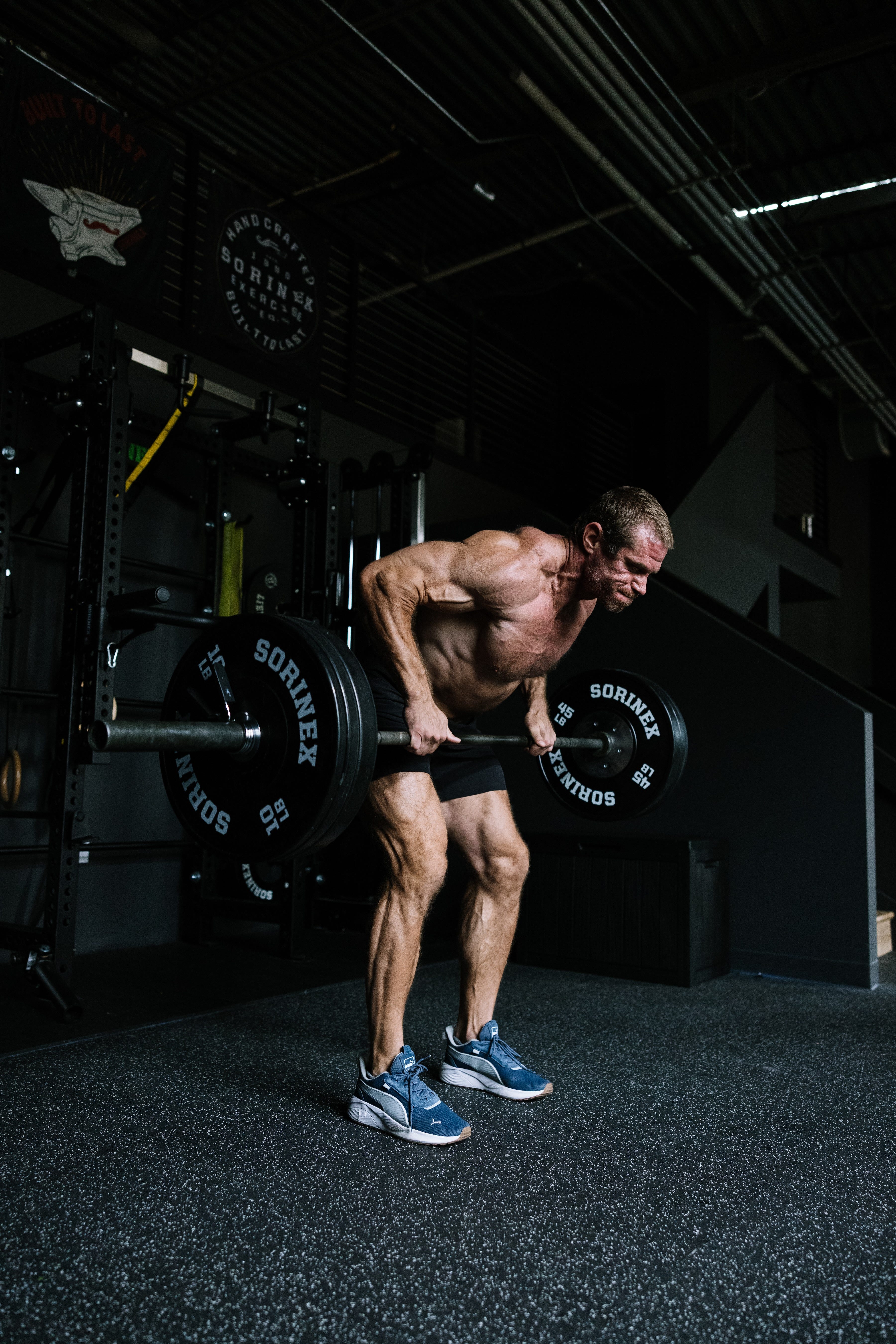
Why Less Works Better After Thirty-Five
A simple fact about getting older that we don’t like to admit is that we simply have less. Less time, less energy, less recovery ability, and maybe less hair in some places and more in others. At this stage of life, finding balance isn’t so much about no longer being passionate but recognizing that our passions have expanded far beyond the gym.
If we are to be there for our family, for our business, and for the other things in life that get us out of bed in the morning, we can’t afford to get injured in the gym, or so sore and drained we can’t get out of that bed without a walker.
So the question is how. How do we continue to get what we need from the gym without it consuming us in the process?
We need to be willing to let go of some notions we thought to be gospel and held dear to our hearts. We can’t handle as much as we used to, that’s the bad news. The good news is that we don’t need as much either.
There’s a good chance you fall into one of two main camps. You are either a total body guy or a body split guy. That means you either believe you must hit every body part directly each session, or that you must trash the handful of body parts you do hit. The truth is that neither is needed.
The Four Movement Patterns
Let’s forget what we know about anatomy for a minute: what each muscle does and all the movements you need to do to fully tax it. Let’s think about the body as a whole. Namely, what major movements does it do?
This can be boiled down to just four major patterns: hinge, squat/lunge, push, and pull. I know, I’m leaving some out, and those are important. But be honest, if someone were to pick just one movement from each of those four patterns and do them progressively for their entire life, how strong and functional would they be compared to everyone else? If someone wasn’t really into “the gym” but they did back squats, weighted dips, chin ups, and deadlifts, heavy, consistently, and safely, would they be healthy and “functional”? Yes, they would.
We have to boil things down to their essentials before we add back in the things that are simply nice to have and enhance the foundation of what we must have.
When you picture those four patterns you likely picture one or two muscles that they work. But the truth is that the large compound lifts that fit into those patterns work far more than that. If someone only does deadlifts and bench press, they will work nearly every muscle in their body. They may not work all those muscles “optimally,” but we must let go of that mental obstacle that we picked up by watching far too many influencers with far more time to train every day than you. Plus, there are things we can add to this protocol that largely address that.
For this protocol you will simply pick two of the four movements per workout. It doesn’t matter how you pair them. If you do two on one day, then simply do the other two the next day. We will get into more detail later.
Now that we’ve covered the basic patterns, let’s get into the other things we need: volume, frequency, and intensity.
Volume
Volume first. We need about five working sets a week to stay strong. That’s it. More is better, especially for size, but it’s not that much better. After the first five sets of the week, each additional set offers a diminishing return on your energy investment, with a non-diminishing return on your recovery requirements. Should we just do the minimum? Probably not. But we don’t need much more than that. If we are older and an advanced lifter, then we don’t need much more than that at all.
But this program doesn’t go by the week, because the body has no idea what a week is. When the ancient Babylonians invented the seven-day week based on the seven observable celestial bodies, they didn’t have your chest and quads in mind. To keep the math simple, we are going to aim for ten sets per pattern every ten days as a minimum target for volume. You will do each pattern every other workout, so that comes out to a minimum of just two working sets per pattern, with three being about the sweet spot, and four being good but on the high end.
Frequency
There are two ways we must look at frequency, but most people only consider one, that being how often you hit a body part. The other consideration is how often you stress the system with heavy resistance training.
Strength is a skill. Skills begin with the nervous system. Each time we stress that system it accumulates fatigue systemically. If we bench one day and squat another, that is one stress for each body part but two stresses on our system. As we become more advanced in the weight room, we are able to impart far more stress on that system with every rep and with every set. Five sets of five hundred pounds is far harder on a system than five sets at one hundred pounds, even if it’s the same level of relative difficulty. This means we need and can handle far less volume than a novice. This factor gets compounded as we age, because the speed at which we recover slows down considerably.
To keep things very simple in this department, we are going to use a simple rule. For every day we lift, we get a day to recover. This means we lift every other day, or five days out of every ten.
Intensity
Intensity comes in two forms as well, how close we are lifting to our maximal strength, and how close we are taking each set to muscular failure.
While you can get bigger using a wide range of weights, to get stronger past a very basic level we need to lift above 80% of our one rep max, at least occasionally. Most people can lift that percentage about eight times, so that will form our upper boundary for repetitions. Unless you are a competitive powerlifter, there’s never really a need to lift much over 90% of your one rep max. Most people can lift this much weight between three to five times. So to simplify things, we will set the minimum number of reps at four. And if we split the difference between three and eight reps we come to five to six. That’s about the perfect number of reps for most of your sets. This will result in the safest and best strength gains, and it will be equally effective at adding muscle size as the higher rep sets with far less fatigue. If you have joint issues, then staying closer to the eight to ten rep range is totally fine.
As far as how close you should get to failure, don’t overthink it. If you know you can get another rep with good form, then go for it. If you think the form will break down, then don’t.
Alternating Vertical and Horizontal
Now let’s dive into some details. Pushing and pulling come in two main varieties, horizontal and vertical. Ideally, you will alternate these. So if you do rows one day, the next time you pull, aim for chin ups, pull ups, or some form of pulldown. The same goes for pushing. If one day is bench press, for example, the next time you do a push should be some sort of overhead press if your shoulders can take that, or maybe an incline press if that’s not an ideal movement for you.
The squat/lunge pattern is the same. Alternate each time.
Finally, you should aim to make about 25%, or one in four, of your movements unilateral. This takes care of itself with the squat/lunge, but at least once a month for the hinge, push, and pull, you should opt for a unilateral option.
The Nice to Have Pieces
If this is all you did, you’d be in a good place. But here’s where we get to the not essential but nice to have parts. There are basically five of these: rotation, carries, power, anterior chain (abs and hip flexors), and isolation movements. Let’s address these in order.
Rotation and Carries
I like to do a rotational movement every other session, and the same goes for carries, so I suggest alternating these. Do a rotational movement one workout and a carry the next. The best place to put these is at the beginning for rotational movements, because they serve as a good warmup, and at the end for the carries, because they serve as a good finisher. Two to three sets of each are perfect. Don’t overthink these.
Power
This protocol covers strength, and strength is an important part of power, but it’s only a part. Ideally, we’d add a power movement in at least every other workout. You can train power for all four movement patterns, but the two that really matter are the squat/lunge and the hinge.
The best way to incorporate these is to either do two to three sets of the power movement just prior to the strength portion of that same movement pattern, or to superset them contrast style. An example of the former would be to do two sets of hang high pulls followed by two sets of deadlifts. Another example would be to do two sets of broad or box jumps followed by two to three sets of squats.
Contrast style would be slightly different. You’d do one set of the strength movement, followed immediately by the power movement. An example here would be a set of five back squats followed immediately by five broad jumps. Either format works and there’s not a clear advantage to doing one over the other.
For sets and reps, keep your power movements the same as your strength: two to four sets of four to eight reps.
Isolation Exercises
There is an important reason to include some isolation work in your program. Many muscle groups cross more than one joint. These are called biarticulate muscles. For these muscles, compound exercises may not fully work them, because they must either act across both joints simultaneously or they must partly relax in order to allow the movement to occur. You can Google Lombard’s paradox to get a better idea of what I’m talking about, but just know that isolation movements have a place, even in a “functional” program.
The good news is these types of exercises don’t take up as much of your recovery room and they don’t require as much rest between sets. You can also safely take them all the way to failure and use slightly higher repetitions to get that pump that we all love. You can do two to four isolation movements per session and two to four sets of each. It doesn’t matter what day you program them on, but put them after your compound lifts. There are times when you can put an isolation movement first, such as something called pre-fatigue, but that’s not something we need to worry about right now.
You can pair these with the main muscles being worked on that day, or you can put them on days where those muscles aren’t being worked on the major compound movements to get some more frequency in. For example, you can pair leg extensions with a lunge day and tricep pushdowns with a bench press day, or you can put leg extensions with a hinge day. It doesn’t matter.
Anterior Chain
This one is simple. Consider adding one “ab exercise” such as ab wheel rollouts or hanging leg raises once every other workout. Two to three sets taken within a rep of failure will suffice.
How to Structure the Days
If you’re a guy who prefers a body split type of program, then you can pair your hinge and squat/lunge together and your push and pull together. Then you can put your isolation movements with those body parts. Here is an example of that type of split.
Body Split Example
Day 1
Deadlifts 3 x 5
Walking Lunges 2 x 8
Leg Extensions 3 x 12
Leg Curls 3 x 10
(You can superset the two isolation movements.)
Day 3
Bench Press 3 x 5
Weighted Chin Ups 3 x 5
Curls 3 x 8
DB Overhead Extensions 3 x 8
Day 5
Back Squats 4 x 4
Single Leg RDLs 3 x 6
Hip Thrusts 3 x 10
Glute Ham Raises 3 x 7
Day 7
Bent Rows 3 x 6
DB Incline Bench Press 3 x 6
DB Lateral Raises 3 x 10
Tricep Pushdowns 3 x 10
Total Body Example
If you’re a total body type of guy, then you can pair an upper movement with a lower movement. Here is an example of that type of split, using rotation, power, anterior chain, and carries as the supplemental movements.
Day 1
Cable Chops 3 x 8
Box Jumps 3 x 6
Zercher Squats 3 x 5
Weighted Dips 3 x 6
Ab Wheel Rollouts 3 x 10
Day 3
Hang High Pulls 3 x 4
Trap Bar Deadlifts 2 x 4
Chin Ups 3 x 5
DB Overhead Carries 3 x 30 yards
Day 5
Split Jumps 3 x 6
Step Ups 3 x 6
Close Grip Bench Press 4 x 4
Hanging Tuck Ups 3 x 10
Day 7
Wall Slams 3 x 6 (power and rotation in one)
Bent Rows 3 x 6
45 Degree Barbell Snatch Grip Hip Extensions 3 x 6
Trap Bar Carries 3 x 30 yards
What to Do on the Other Days
This is pretty obvious: cardio or sprints. Your cardio should be one of four forms, and ideally you’ll rotate through these: zone 2, VO2 max, HIIT, or SIT (sprint interval training). You only need one or two cardio sessions per week to stay healthy, and I wouldn’t do more than three.
If you do the math there, you’ll be working out about four times a week on the low end and six times a week on the high end, but no workout will be over an hour, and no workout should leave you trashed. Another option is to double up occasionally and do your weight session early in the day and a short cardio session later in the day.
For sprinting, the only thing that comes close to being a rule is to not sprint after a hinge day. Ideally you don’t want your hamstrings fatigued going into a sprint session.
The Bottom Line
Remember, everything but the two patterns is nice but not essential. If life gets hectic, then two patterns every other day is all you’ll need to stay strong and functional until things calm down again.
Killer post 💪
Great article, Mr. Lienhard. Love your stuff. As someone trying to stay strong and prevent injuries, I'd be curious to know how you allocate warm-up and pre-hab time into your workouts. For example, on my squat days, I'll do: 1) Brief run or stationary bike to warm up 2) Ankle mobility (banded distractions), 3) hamstring flosses, 4) hip flexor stretch + resistance, 5) hip adductor warm-up (Cossack squats), and 6) hip abduction movements. All that makes me feel great but usually takes 30+ minutes and I tend to run out of time for the workout itself unless I can spend about two hours in the gym. How much time do you take in your workouts for similar things? Any guidance is deeply appreciated.